

Search for articles or browse our knowledge portal by topic.
Introduction to Performance-Based Roadway Design
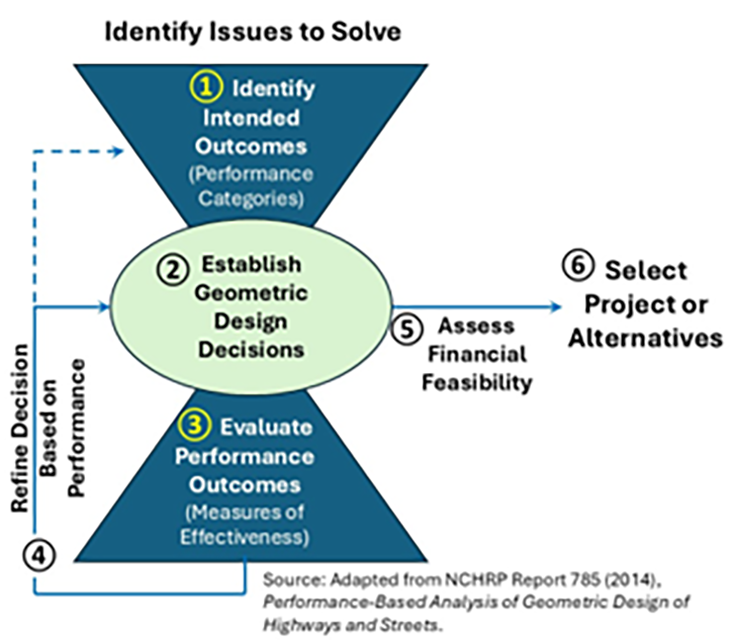
Until the late 1980s, the standard operating practice among roadway designers was to apply prescriptive design criteria with the expectation that doing so would result in required safety and operational improvements. This approach afforded designers little flexibility to tailor designs to individual project contexts. Recognizing the shortcomings of this perspective, in the 1990s transportation agencies gravitated toward new methods of project development and roadway design focused on identifying context-adapted solutions. Rooted in a commitment to balancing project community and environmental needs with clearly defined performance targets, these methods have helped transportation agencies deliver better-performing projects. These approaches to design have been iterated and improved upon over the last 30 years. Each iteration has gone by a different name — context sensitive design, practical solutions, performance-based flexible solutions, and performance-based design.
KYTC has supported and evolved with these approaches as the highway industry has changed. For the Cabinet, performance-based design provides a practical way to achieve measurable safety and operational improvements while working within real-world constraints of budget, context, and constructability.
The basic premises of performance-based design are straightforward:
- Keep project scopes narrowly focused on project needs without unnecessarily exceeding them.
- Evaluate quantitative and/or qualitative data to determine which alternative maximizes the safety, benefit-cost ratio, and performance value.
- Apply principles of the Safe System Approach throughout project development to ensure the chosen alternative is context-adapted and will deliver safe mobility to all roadway users.
- If an existing road’s design does not comply with geometric design criteria but no safety or operational issues have been observed or are forecasted, a project should not be undertaken solely to achieve compliance with design standards.
- Never compromise on safety.
KYTC, like all state transportation agencies, has an expansive road network and limited financial and personnel resources. Making observed and forecasted performance the central focus of project development and design, rather than strict adherence to prescriptive design criteria, allows the Cabinet to allocate its resources more efficiently. What matters is real-world performance. Table 1 contrasts the philosophies and goals underpinning traditional design and performance-based design. Performance-based design fosters not only flexibility, but encourages designers to unleash their creativity and imagination so they can identify a solution that dovetails with the project context.
| Table 1. Comparison of Traditional and Performance-Based Design | ||
|---|---|---|
| Design Consideration | Traditional Design | Performance-Based |
| Project Scope | Meet design standards. | Identify and address project need(s). |
| Safety | Nominal safety. Assumes that meeting design standards will deliver the targeted safety perfor-mance. | Apply the Safe System Approach by implementing context-based safety strategies and assessing predictive performance using Highway Safety Manual (HSM) methodologies. |
| Context | Geometric features are selected based on functional classification and standards. | Context classification, land use, and mix of facility users inform the geometric design decisions. |
| Traffic Operations | Design accommodates traffic volumes forecasted 20+ years into the future. | Identify opportunities to address short-term needs that can immediately improve per-formance. |
| Design Speed | Use design criteria for the posted speed. | Consider adopting a design speed that re-sults in the intended operating speed. |
| Measure of Success | Meet all design standards. | Deliver improved performance over the existing roadway — a design-up philosophy. |
| Use of Design Exceptions and Variances | No or few design exceptions. | Design exceptions and variances chosen based on sound engineering judgment are encouraged. All variances and exceptions must be properly justified and documented. |
| Funding | Design to prescriptive criteria regardless of how long it takes to secure design and construction fund-ing. | Explore cost-effective and meaningful improvements that can be implemented in the near term. |
Designers and project teams should think expansively about what performance measure they use to evaluate alternatives. An example of an alternative comparison can be seen in Figure 1. Common performance measures include expected crash frequency and severity, traffic operations efficiency (e.g., volume/capacity, speed), travel times or delays, non-motorized user safety, user accommodations (e.g., vehicle tracking on truck routes, pedestrian facilities), and extent and cost impacts to right of way, utilities, and the environment. Not all performance measures are quantitative. Qualitative metrics may be necessary to capture the full impact on community livability and socioeconomic conditions.
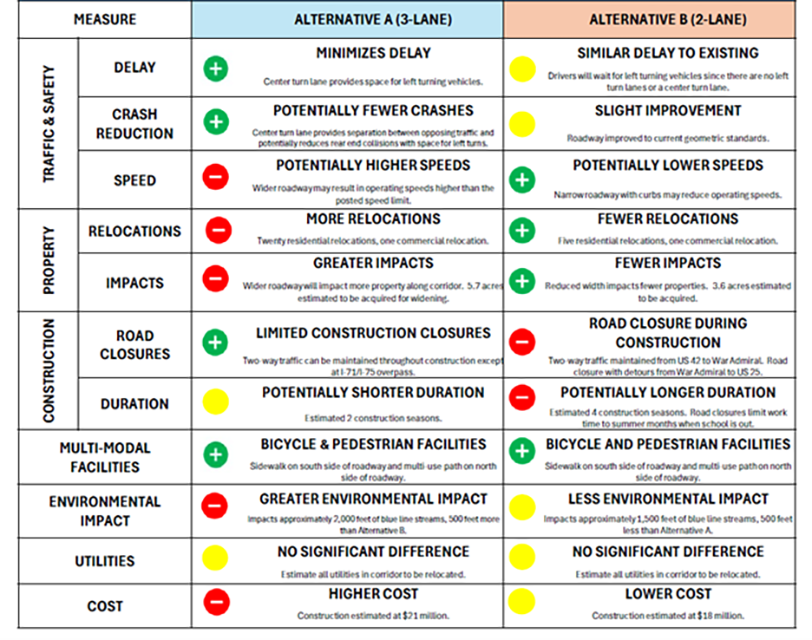
Figure 1. Example Comparison of Alternative Performance Measures
A best practice is to select performance measures most closely aligned to a project’s needs and goals. In other words, use metrics that provide the best insights into aspects of roadway operation being addressed by the project. Using these metrics lets project teams understand how alternatives perform relative to one another and to existing conditions (i.e., analyze build versus no-build scenarios). Safety should be a goal for every project, even when it is not explicitly identified as a need. Consider incorporating programmatic, low-cost safety measures that are appropriate to the project context and have been shown to improve safety on similar roadways.
All projects wrestle with issues of cost, and project teams have to judiciously weigh costs associated with different alternatives to select one that provides the greatest value. No simple rubric is available that can be used to evaluate the value proposition of different alternatives. Ideally, the alternative that promises the highest level of performance along every dimension would be chosen. But this may not be feasible when the amount of money required to select the highest-performing alternative on every project would severely limit KYTC’s highway program and the ability to tackle projects throughout the state’s transportation network. Benefit-cost analysis and other performance measures that are expressed in monetary terms (e.g., travel time savings, cost of crashes) are valuable for assessing the economic implications of different alternatives for the Cabinet, roadway users, and communities.
Approaching design with a performance-based mindset demands that project teams think critically about the benefits of each alternative, how well each alternative addresses project needs, and whether an alternative’s cost can be justified based on the anticipated outcomes.
The HKP article Project Development Performance Measures (coming soon) provides additional information on specific performance measures and the situations in which they are best applied.
Ray, B. L. (2016). Performance-Based Analysis of Roadway Geometric Design. ACEC-KY/FHWA/KYTC Partnering Conference. Kentucky Transportation Cabinet. https://transportation.ky.gov/Highway-Design/Conference%20Presentation/Performance%20Based%20Geometric%20Design%20-%20Brian%20Ray.pdf
KYTC. Highway Design Manual. HD-703.7 Performance Based Flexible Solutions. https://transportation.ky.gov/Organizational-Resources/Policy%20Manuals%20Library/Highway%20Design.pdf
KYTC. Design Memorandum No. 03-17. Division of Highway Design, Kentucky Transportation Cabinet, 2017, https://transportation.ky.gov/Highway-Design/Memos/03-17.pdf .
FHWA Flexibility in Highway Design
- Although issued in 1997, this foundational document helped set the stage for roadway design to evolve from its historical focus on nominal safety and prescriptive standards to context-adapted design practices.
FHWA Performance-Based Practical Design
- A high-level introduction to performance-based design that includes case studies, implementation guidelines, and links to additional resources.
NCHRP Report 785 Performance-Based Analysis of Geometric Design of Highways and Streets
- Provides a framework and tools for evaluating how roadway geometric design decisions influence safety and operational performance, enabling designers to use quantitative, performance-based methods rather than relying solely on prescriptive criteria.
NCHRP Report 839 A Performance-Based Highway Geometric Design Process
- Proposes workflows for executing performance-based project development and design and includes geometric design criteria that can inform design activities in different contexts.